Choosing your wedding videography coverage becomes easier when you start with the moments you want to remember. Your preparations, ceremony, time together, speeches and party each bring something different to the film. The question is how those moments fit into your actual day.
At Santorini.video, we help couples choose their hours by looking at the programme, locations, travel and priorities together. A well organised six hour booking can cover a substantial part of a wedding. A celebration that includes preparations, dinner, speeches and a lively party generally needs a longer window.
Our aim is to recommend enough time to preserve what matters to you, with a realistic schedule that lets you enjoy the experience.
A Starting Point for Choosing Your Coverage
These are our usual planning guidelines for Santorini. We check the details of your programme before confirming what will fit.
| Coverage | What we usually plan around | What to consider |
|---|---|---|
| 3 hours | Ceremony and couple’s session, or preparations and ceremony. | A little of all three may fit when everything is very close together. |
| 6 hours | Preparations, ceremony, couple’s session and the beginning of dinner. | A strong starting point for covering much of the day without staying through the full evening programme. |
| 8 hours | The main daytime coverage with additional time for portraits, guests or selected reception events. | We choose the priorities around your schedule rather than assume the entire evening will fit. |
| 10 hours | Preparations through dinner, speeches and party coverage. | Our recommendation when you want the full progression of the celebration, with the finishing time checked against the programme. |
What Can We Film in Three Hours?
Three hours is our minimum wedding video booking. It can work well for a focused celebration, particularly when the ceremony and portraits take place in the same area.
If your preparations, ceremony and couple’s session are all within one venue or a very compact route, we may be able to capture a little of the preparations, the ceremony and a walk together afterwards.
If the hotel is farther from the ceremony venue, we usually need to prioritise. That might mean preparations and the ceremony, or the ceremony followed by portraits. Moving between places uses part of the booking, so we cannot treat three hours across several locations as equivalent to three hours in one place.
For a short booking, choosing what matters most gives us a much better foundation than trying to squeeze in every possible part of the day.
Six Hours: Much of the Wedding Day
Six hours is a useful starting point for preparations, the ceremony, your couple’s session and the beginning of dinner. This can work for both an elopement and a wedding with guests, depending on the programme.
Compared with a shorter booking, we have more room to approach the preparations creatively and spend time filming you together. A second portrait location may also be possible if the route and timing support it.
This coverage can preserve a substantial part of the wedding. However, if speeches, dinner and dancing extend further into the evening, we need to plan for that separately. The beginning of dinner and a complete evening celebration are different points in the timeline.
Eight Hours: Decide What the Extra Time Is For
Eight hours sits between the main daytime story and fuller evening coverage. The extra time can give us a more relaxed portrait session, more interactions with guests or selected reception events.
The value depends on how you use those hours. If an important speech or your first dance falls within that window, it may be exactly the right fit. If the evening programme starts much later, eight hours may still finish before the moments you most want recorded.
For an elopement, a longer booking creates different possibilities. We might explore several locations or spend more time in a larger village such as Oia. The number of stops depends on travel, walking, clothing and the pace of the photo and video session. We plan a route that gives each location enough attention.
Ten Hours: Dinner, Speeches and the Party
If you want preparations, the ceremony, portraits, dinner, speeches and party footage, we recommend planning for ten hours. This gives us a broader window to follow the celebration as it develops.
Speeches need space in the programme. Dinner takes time, and the party does not always begin immediately afterwards. We look at when the key events are actually scheduled before agreeing on the start and finish of coverage.
Even with a longer booking, the timing matters. If you want an event that happens late at night included, we need to make sure the agreed finishing time reaches it.
Are Preparations Worth Filming?
We enjoy approaching preparations creatively. They can introduce the people, energy and anticipation of the day before the ceremony begins.
You do not need a room full of accessories to make this part meaningful. A dress, something comfortable to wear beforehand and a little thought about the setting can be enough to create beautiful scenes. If you have meaningful jewellery, letters or other details, we can include those too.
Before the wedding, we can discuss references and ideas that suit you. During preparations, we might film:
- Writing or quietly reading your vows.
- Time with friends or family before getting dressed.
- A few relaxed moments with a drink and conversation.
- The final touches to hair and makeup.
- Putting on the dress, jacket, jewellery or other finishing details.
For the beauty portion, we generally prefer arriving when makeup is already largely complete and the stylist is working on the finishing touches. This helps us use the filming time well and capture you feeling ready.
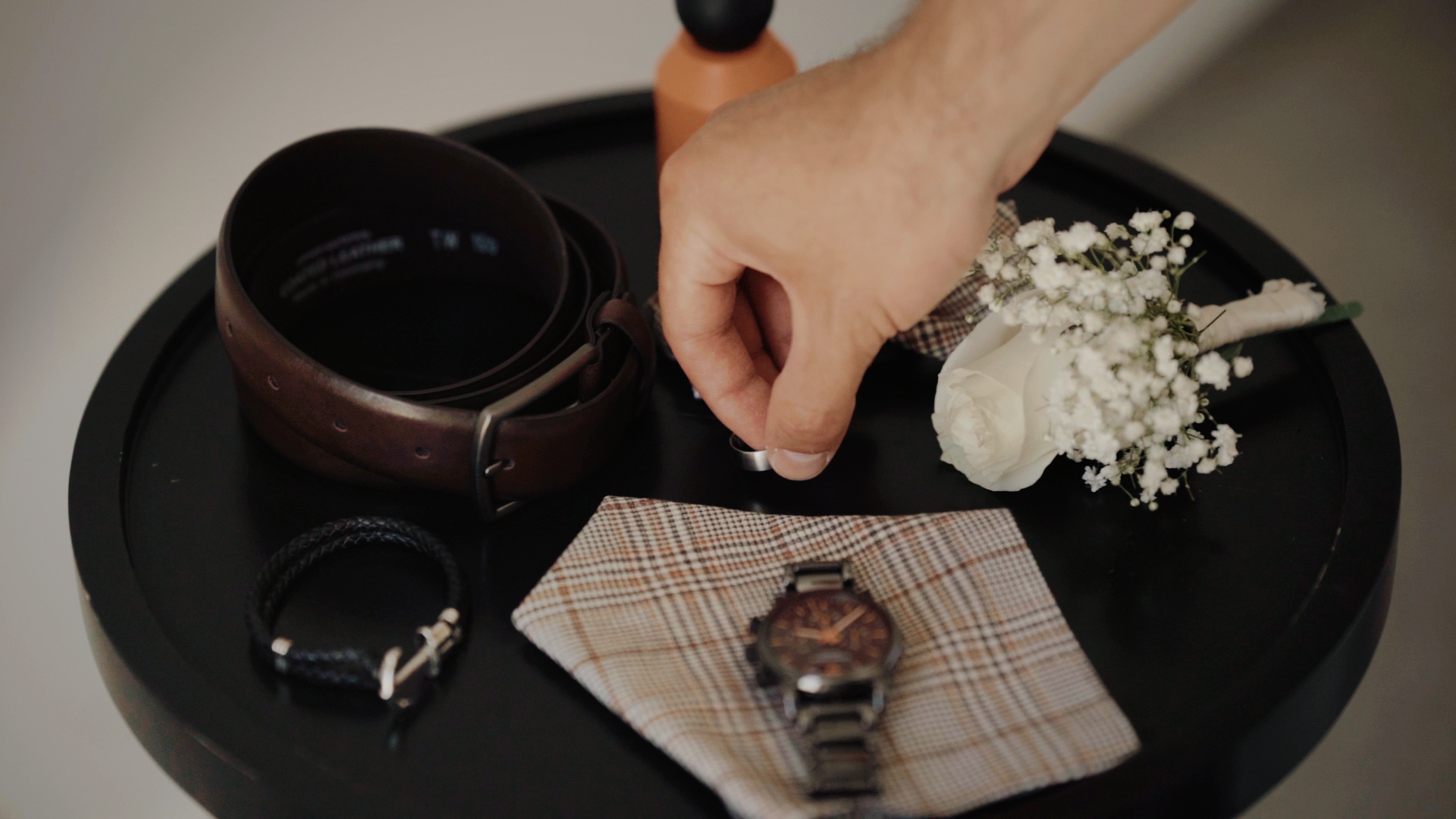
Groom preparations often need less filming time, but organisation still matters. Having clothing and accessories ready, and making sure everyone knows when we arrive, helps avoid losing the available window to waiting.
Why Short Distances Can Still Take Time in Santorini
Many Santorini locations look close together on a map. The practical journey also includes traffic, finding parking, unloading equipment and walking to the exact place where we will film.
Your transfer may be able to drop you near the entrance while the photographer and videographer need to park their own vehicles and carry equipment to meet you. Those are different arrival times, and both need to be included in the plan.
Access arrangements can change between seasons. This is why we review the route with the team working on your wedding and coordinate with your planner before finalising the schedule.
A short stop can produce a few lovely frames, but it does not give us the same possibilities as a session with time to explore, guide movement and build several scenes. We want the expectations to match the time available.
Your Clothes and Photography Plans Affect the Timing Too
A long dress, a full skirt, steps and changes of shoes all influence how quickly you move between locations. If wearing heels in every scene matters to you, we allow for changing into them and getting comfortably into position.
These details are part of planning a session around you. We would rather ask in advance than discover on the day that the proposed route requires a pace you cannot comfortably maintain.
The photographer’s approach also affects the schedule. Some scenes work naturally for both photography and video; others need separate direction. A still pose and a moving sequence take different kinds of attention.
We coordinate with the photographer so both teams have the opportunity to create their work. The couple should have clear instructions and enough time to follow them without feeling pulled between cameras.
Coverage Hours Run Continuously
Your booked hours run continuously from the agreed start time to the agreed finishing time. Travel, waiting and dinner are included in that period.
For example, six hours beginning at 3 pm finish at 9 pm. A journey between venues or a pause while dinner is served does not stop the clock.
The team remains committed to your wedding throughout that window. We need to be available for the next event and ready if the programme changes. Understanding this from the start helps you choose coverage that reflects the full schedule.
How Much of the Party Should We Film?
If the dance floor becomes lively straight away, around half an hour of active party coverage can give us a strong collection of scenes. The music, guests and energy of the evening all influence how quickly that happens.
Some celebrations are quieter. If your guests prefer conversation and a relaxed dinner, extra time does not automatically create dance footage. We want the film to reflect the atmosphere of your wedding.
Equally, an unexpectedly wonderful party can be worth staying for. The reactions, movement and shared fun bring a different energy to the film, particularly when games, a bouquet toss or other events are still to come.
Can We Add an Extra Hour on the Day?
In almost all of our bookings, staying for an additional hour is possible. If another commitment limits our availability, we discuss that with you in advance. This can occasionally happen with an earlier daytime booking.
An extension can be useful if the party is in full swing or an important event is about to happen. Let us know before the agreed finishing time so we can confirm the arrangement and additional charge.
For events you already know are essential, such as speeches, the first dance or the cake cutting, we recommend including them in the original coverage plan. The option to extend gives you flexibility when the day develops differently.
More Hours or a Second Videographer?
Additional hours allow us to stay for later parts of the celebration. A second videographer allows us to capture different things happening at the same time.
During a ceremony, one operator can follow the entrance while another records the waiting partner’s reaction. During speeches, one can stay with the speaker while the other captures the couple or their parents. Those simultaneous reactions can be especially valuable.
A second camera on a tripod can provide a continuous view, but it cannot actively look for an unexpected reaction or change its composition in the way another operator can.
The venue layout matters too. An intimate terrace can become crowded when photographers, videographers and content creators all need positions. We assess the available space and the responsibilities of the whole team before recommending another person.
For a larger celebration, separate preparations or several events taking place at once, a second videographer may add significant value. For a compact event in a small space, one videographer with a well planned schedule may be the better fit.
How We Help You Choose
Send us your draft programme, preparation locations, ceremony venue and reception plans. Tell us which moments you definitely want in your film and whether you would like to visit additional portrait locations.
We will review the practical details with you, including travel, walking, the photography session and the timing of the evening events. From there, we can recommend coverage that gives your priorities the time they need.
Contact Santorini.video to discuss your wedding or elopement timeline and choose the right number of filming hours for your day.